

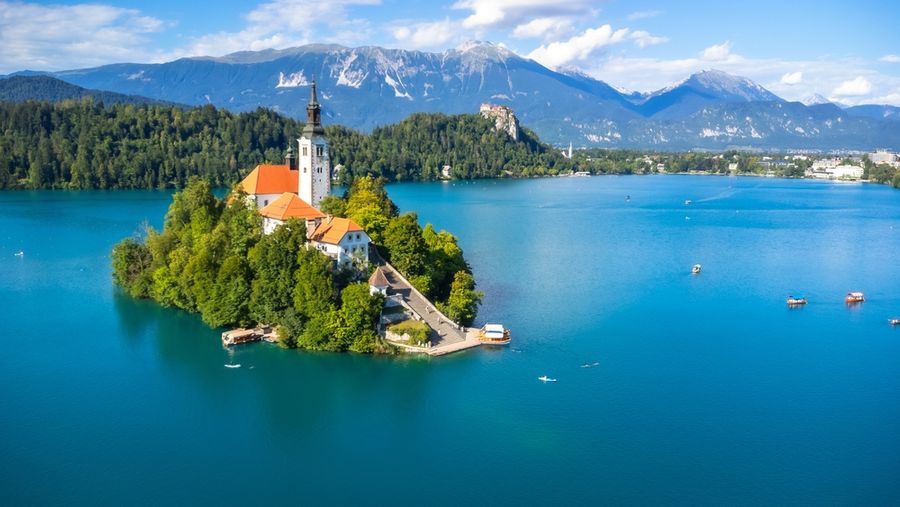
There are places in the world that look exactly like their photographs, and Lake Bled in Slovenia is one of them. Tucked into the Julian Alps in the country's northwest corner, the lake holds a tiny island at its center with a church rising from the trees. A castle watches from a cliff above the shore. Together, they create a scene that feels almost too composed to be real—yet every year, travelers from across the globe make the trip to see it.
A Castle With Deep Roots
Standing high on a rocky cliff above the lake, Bled Castle has watched over the valley for more than a thousand years. Its story goes back to the year 1004, when the German king Henry II passed the Bled estate to a bishop as a gift. By around 1011, those same bishops had built the first proper castle on the hilltop, intended mainly as a defensive structure rather than a place of comfort or display (source).
The castle grew steadily over the following centuries, with towers and fortified walls added during the Middle Ages. It was badly damaged by earthquakes in both 1511 and 1690, and required significant reconstruction after each event (source). A fire in 1947 caused yet more destruction, and it took the local community until 1961 to fully restore the site for visitors—a project that ran for the better part of a decade. Today the castle holds a museum, a wine cellar, a restaurant, and a working printing workshop, giving visitors plenty of reasons to spend time exploring its courtyards beyond the views alone.
The Island at the Heart of the Lake
The small wooded island sitting in the middle of the lake may be the most recognized spot in all of Slovenia. At its center stands the Church of the Mother of God on the Lake, a pilgrimage site that has drawn believers and curious visitors alike for generations (source). To reach the church from the dock, visitors must climb a stone staircase of 99 steps that rises steeply from the water's edge (source).
At the top of those steps, inside the church, hangs the Wishing Bell (source). The tradition of ringing it while making a wish runs deep here, and many visitors treat the climb and the bell as a kind of small personal ritual. The island is open to visitors every day of the year, meaning it fits into a trip no matter the season or the weather (source). Even in winter, when mist sits over the water, the island has a stillness to it that is hard to find anywhere else.
Getting to the Island: The Pletna Boat
There is one traditional way to cross the lake to the island, and that is by pletna—a flat-bottomed wooden boat that has been carrying passengers here for centuries. The history of the pletna stretches back to the late 1500s, and the boats are still built by hand today using a design that has changed very little over the years (source).
What makes a pletna ride memorable is how the boat moves. The oarsman—called a pletnar—does not sit to row. Instead, they stand upright at the stern and propel the boat forward using a technique with two oars, a method known as "stehrudder" that has been handed down within families across generations (source). The right to operate a pletna was historically tied to families who received less productive farmland, with ownership passed from parent to child over hundreds of years. The lake is currently served by 23 of these boats, with pletnarji welcoming passengers from several points along the shore (source).
Into the Mountains: Hiking Around Bled
For visitors who want to explore beyond the water, Bled sits on the doorstep of some of Slovenia's finest hiking country. The area has been tied to mountaineering for well over a century, and the surrounding peaks offer routes that range from easy walks to full-day mountain climbs. In every direction, trails lead up through forest and rock to views that put the whole valley into perspective.
One of the most exciting additions to the trail network is the Juliana Trail, a circular hiking route that opened in 2019. Stretching 330 kilometres in total, it winds through valleys and mountain passes along the outer edges of both the Julian Alps and Triglav National Park (source). The trail is laid out across 20 stages, with each covering between 18 and 25 kilometres—a pace designed to let walkers take in the landscape rather than rush through it (source). For those with less time, shorter trails above the lake offer sweeping aerial views of the island and the castle that rival anything you can see from the shore.
A Place That Lives Up to the Pictures
Lake Bled is one of those rare travel destinations that genuinely matches what people imagine before they arrive. The combination of an ancient hilltop castle, a church on a lake island, handmade wooden boats, and mountain trails threading through the Julian Alps gives the area a richness that goes well beyond a single postcard image.
For American travelers looking for somewhere in Europe that is quieter than the major capital cities but just as layered and rewarding to explore, Lake Bled makes a strong case for itself. The history runs deep, the setting is remarkable in every season, and the pace of a visit naturally slows down in all the right ways. It is the kind of place that tends to make people wonder why they waited so long to go.