

Patagonia sits at the very bottom of South America, spanning parts of both Chile and Argentina. It is a land of towering granite peaks, ancient glaciers, and wildlife found nowhere else on Earth. For American travelers dreaming of an unforgettable adventure, the big question is simple: which side should you visit? Both countries are completely different, so it's important to understand what each side offers before you book your trip.
The Landscapes: Granite Towers vs. Open Ice
When it comes to pure scenery, the Chilean side is hard to beat. Torres del Paine National Park is the crown jewel of Chilean Patagonia, filled with dramatic pointed granite spires, snow-capped mountains, bright blue lakes, and wide golden plains that stretch to the horizon (source). These are the kinds of views that end up on magazine covers — and they live up to every bit of the hype in person.
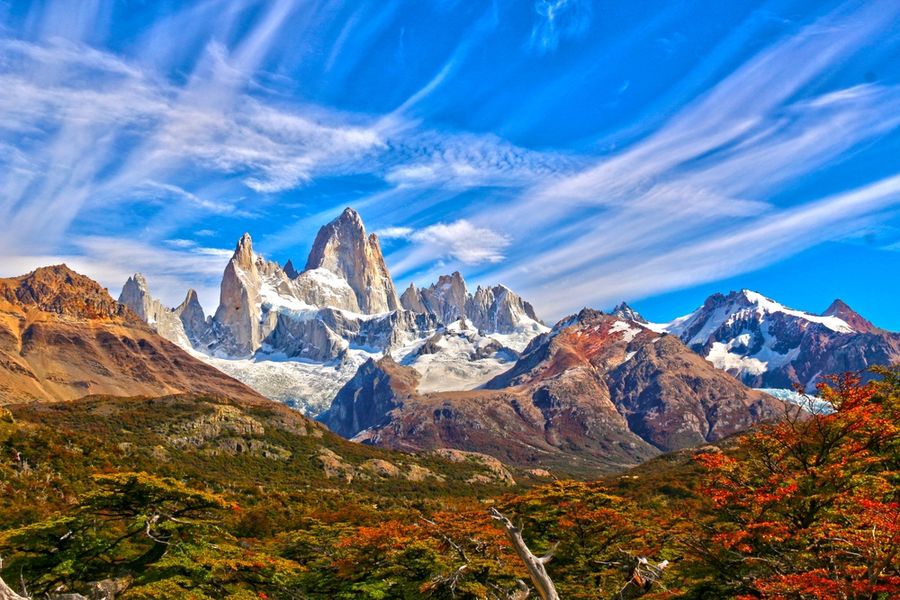
Argentina's answer to Torres del Paine is Mount Fitz Roy, a jagged and iconic mountain that draws hikers and photographers from across the globe (source). The small town of El Chaltén sits at its base and serves as the main starting point for the surrounding trails, which offer some of the most striking mountain scenery in all of South America (source). Both landscapes are breathtaking in their own right, but if you are pressed to choose just one park for sheer visual impact, Torres del Paine holds a slight edge for most visitors.
Wildlife: Argentina Takes the Lead
If spotting animals is your top priority, Argentina is the stronger pick. On the Argentine side, the city of Ushuaia gives travelers the chance to see Magellanic penguins, fur seals, and the brightly colored austral parakeet. Tierra del Fuego National Park, located just outside the city, is also home to red foxes, beavers, condors, and eagles (source).
Farther north along Argentina's Atlantic coast, the Valdés Peninsula near Puerto Madryn is one of the continent's best wildlife destinations. Visitors can spot sea lions, orcas, elephant seals, and penguins along the shoreline (source). The peninsula is also a top whale-watching spot, with September and October being among the best months for sightings (source). Chile is not without wildlife — guanacos roam freely across the Patagonian grasslands, and the elusive puma lives within Torres del Paine — but Argentina simply offers more variety, especially for those hoping to see marine life up close.
Getting Around: Easy Roads vs. Wild Exploration
How you travel through each side of Patagonia is very different, and it plays a big role in shaping your trip. Argentine Patagonia is enormous, stretching from the city of Ushuaia in the far south all the way north to San Carlos de Bariloche, and from the Chilean border east to Puerto Madryn on the Atlantic coast (source). Most of the key sights have airports nearby, making logistics relatively straightforward. El Calafate, for example, has its own airport and is the gateway town to the famous Perito Moreno Glacier, a towering wall of blue ice set within the UNESCO-listed Los Glaciares National Park (source).
Chile's geography is more complex. Much of Chilean Patagonia is a tangle of fjords, islands, channels, and mountains with no roads connecting them, meaning some areas can only be reached by boat or small plane (source). That said, Chile is home to the Carretera Austral — officially known as Ruta 7 — a legendary scenic road that winds through forests, valleys, and past glacial lakes (source). Many sections of the road are unpaved and require ferry crossings to move between stretches of highway, making it a true adventure for self-drive travelers who enjoy the unexpected (source). Along the way, highlights like the marble caves at General Carrera Lake make the journey worth every bump in the road.
Food, Culture, and the Gateway Cities
The food and culture on each side reflect the spirit of each country. Argentina's Patagonia region is known for its roasted lamb, world-class beef, and excellent Malbec wine, particularly around the town of El Calafate (source). Chile has its own local specialties worth trying, including Patagonian lamb and king crab, which are both popular in and around the towns of Puerto Natales and Punta Arenas.
Before reaching Patagonia, most American travelers fly into Buenos Aires for Argentina or Santiago for Chile (source). Buenos Aires is a grand, energetic city celebrated for its architecture, tango culture, and lively neighborhoods. Santiago, meanwhile, is a polished modern city close to excellent wineries and set against a backdrop of Andean peaks. Both cities make for a rewarding start or finish to a Patagonian adventure, and both are served by direct or one-stop flights from major U.S. hubs.
The Verdict: You May Not Have to Choose at All
There is truly no wrong answer when deciding between Chilean and Argentine Patagonia. Both sides are extraordinary, and many travelers find a way to visit both during a single trip — the Perito Moreno Glacier in Argentina and Torres del Paine in Chile are only about a 3.5-hour drive apart via a road link between the towns (source). That means you can stand before a wall of ancient ice one morning and hike beneath granite spires the next.
If your time is limited and you want the most iconic landscapes in the fewest days, focus on Chilean Patagonia and Torres del Paine (source). If wildlife, glaciers, and a greater range of towns and experiences are what you are after, lean toward Argentina — or start there and cross the border into Chile for a finale you will never forget. Patagonia rewards travelers who go all in.