

Canada is one of the few countries where a road trip can take you from Atlantic fishing villages to Pacific rainforests without ever leaving home. The country spans six time zones and holds everything from desert badlands to Arctic tundra. You can drive for days and still feel like you've barely scratched the surface. The Great White North boasts routes that cover the most rewarding stretches of road in the country, whether you have a day or a week.
The Icefields Parkway, Alberta
Length: 2-3 days
Best for: Anyone who wants dramatic mountain scenery without complicated logistics.
The Icefields Parkway runs 232 kilometres between Banff and Jasper in Alberta. It consistently ranks as one of the most scenic drives on earth, and for once, that claim holds up. On a clear day, you'll pass turquoise glacier-fed lakes, waterfalls tumbling off cliff faces, and mountain peaks that look painted on.
Start in Banff and give yourself at least two full days — ideally three. Stop at Peyto Lake early in the morning before tour buses arrive. Walk the short trail at Athabasca Falls in Jasper. In summer, book accommodation months in advance; the towns along this corridor fill up fast.
Fuel up before you leave Banff. Gas stations along the Parkway are sparse, and the ones that exist charge a premium. A standard sedan handles this route fine — you don't need a truck or SUV.
Cape Breton's Cabot Trail, Nova Scotia
Length: 2-3 days
Best for: Couples, solo travellers, and anyone chasing coastal views and fresh seafood.
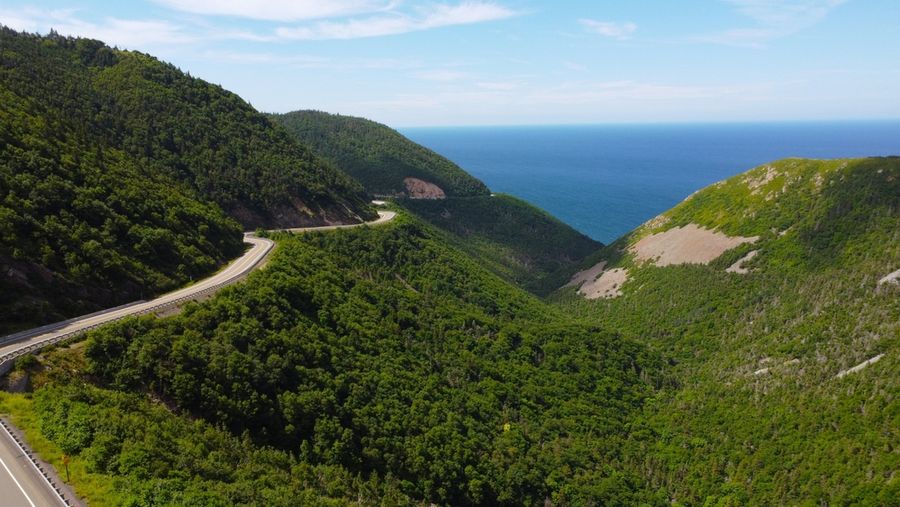
The Cabot Trail loops 298 kilometres around the northern tip of Cape Breton Island in Nova Scotia. The road hugs cliff edges above the Atlantic, drops into Mi'kmaw communities, and cuts through Cape Breton Highlands National Park. It's the kind of drive where you stop every 20 minutes because something new demands your attention.
Drive the loop counterclockwise — that puts you on the ocean side for the most dramatic sections. The stretch between Cheticamp and Pleasant Bay offers some of the best coastal views in Atlantic Canada. Stop in Cheticamp for fish chowder and a look at the local Acadian culture before heading into the highlands.
In October, the fall colours are exceptional. The maples and birches turn red, orange, and yellow against the dark blue of the Atlantic. If you enjoy it, plan to camp along the way.
The Sea-to-Sky Highway, British Columbia
Length: 1-2 days
Best for: Outdoor enthusiasts who want to pack hiking, cycling, and sightseeing into a single route.
Highway 99 from Vancouver to Whistler covers about 120 kilometres, but the scenery punches well above its distance. The road climbs from sea level through coastal rainforest, passing Shannon Falls, Brandywine Falls, and a series of peaks that define the Coast Mountains. Whistler sits at the top, one of North America's most famous ski and mountain bike destinations.
Stop at Shannon Falls Provincial Park early — it's only a five-minute walk from the parking lot to the base of BC's third-highest waterfall. In Squamish, the Sea to Sky Gondola lifts you above the treeline in under 10 minutes and delivers 360-degree views of the Howe Sound fjord. On a clear day, it's worth every dollar of the ticket price.
This route works year-round, but summer and fall offer the most flexibility. Winter driving requires snow tires. Give yourself a full day for the drive if you plan to stop, or two days if you want to hike anything serious.
The Trans-Canada Through the Prairies, Saskatchewan and Manitoba
Length: 3-4 days
Best for: Travellers who want to slow down, think clearly, and experience a landscape unlike anything in Europe or the United States.
Most people skip the Prairies. That's a mistake. The stretch of Trans-Canada Highway between Regina and Winnipeg — roughly 575 kilometres — offers something rare: space. The sky is enormous out here. You can watch a thunderstorm build on the horizon an hour before it arrives. At night, the Milky Way is visible in a way it simply isn't near a major city.
Stop at the RCMP Heritage Centre in Regina to understand how the national police force shaped the country's west. Drive through the Qu'Appelle Valley, a glacial river valley that cuts through the otherwise flat landscape like a surprise. In Winnipeg, spend time in the Exchange District and visit the Canadian Museum for Human Rights, one of the most architecturally striking buildings in the country.
This route rewards patience. It's not built for rushing. If you approach it with curiosity instead of a checklist, it'll stay with you longer than the mountain drives.
The Fundy Trail and Lighthouse Route, New Brunswick and Nova Scotia
Length: 5-7 days
Best for: History buffs, tide-watchers, and travellers who prefer roads less driven.
The Bay of Fundy has the highest tides in the world — the water rises and falls up to 16 metres twice a day. The coastal roads along New Brunswick's Fundy shore and Nova Scotia's South Shore Lighthouse Route put that phenomenon at the centre of the trip. Start in Moncton and drive west through Sussex toward the Fundy Trail Parkway, a protected stretch of coastline accessible by foot and bike.
At Hopewell Rocks, you can walk on the ocean floor at low tide and kayak past the same sea stacks at high tide — just not on the same day without careful planning. Check the tide tables before you go. Timing is everything here.
Cross into Nova Scotia and follow the Lighthouse Route through Lunenburg, a UNESCO World Heritage site with colourful 18th-century architecture. The town is small and walkable. Local restaurants serve scallops pulled from the bay that week. Finish the loop back through Halifax, where the waterfront offers a good final meal before the drive home.
Allow five to seven days for this full circuit. The distances are manageable, but the stopping points are generous.
A Few Practical Notes
Pack a paper map or download offline maps before you leave. Cell service disappears on most of these routes. Carry water, snacks, and a basic emergency kit — a flat tire in a remote area feels less stressful with a jack and a spare already in the trunk.
Book accommodation early if you're travelling in July or August. Canada's national parks are popular, and the good campsites and lodges reserve out months ahead. Shoulder season — May, June, September, or October — offers thinner crowds and, on many routes, better light for photography.
The best road trips in Canada share one thing: they reward the traveller who slows down. Pull over when something catches your eye. The schedule can wait.