

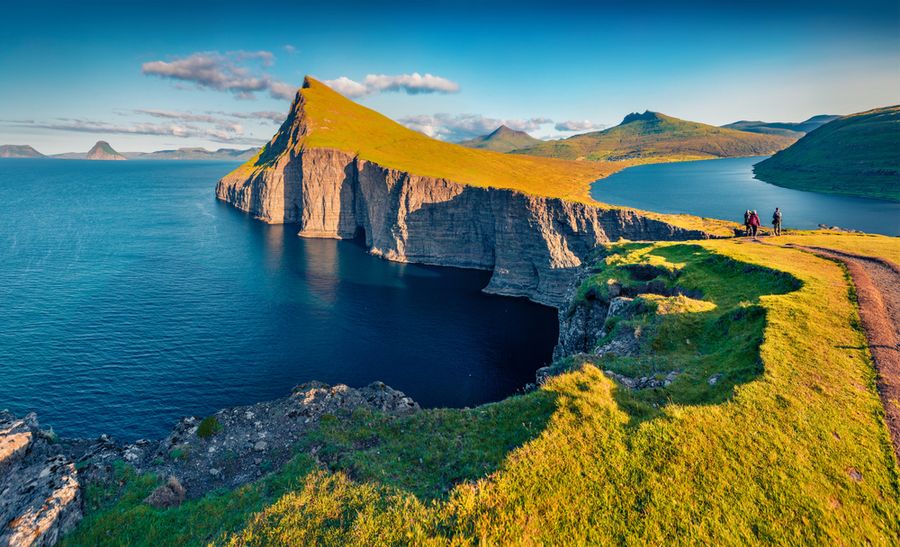
Some places feel like they belong in a fairy tale rather than on a map. The Faroe Islands — a cluster of 18 rugged islands tucked between Iceland and Scotland's Shetland Islands in the North Atlantic Ocean — is one of those places. With its towering sea cliffs, sweeping green valleys, and colorful villages dressed in grass rooftops, the archipelago rewards every traveler willing to make the journey. Understand why the Faroe Islands deserve a top spot on your scenic travel bucket list.
A Landscape That Looks Like It Doesn't Belong Here
There are few places in the world that stop you in your tracks the moment you arrive. Made up of 18 rugged islands situated halfway between Iceland and Scotland's Shetland Islands, the Faroe Islands sits deep in the heart of the North Atlantic Ocean (source). From the moment you step off the plane, the scenery demands your full attention.
What makes the Faroes so visually striking is the sheer drama of its natural features. Steep volcanic cliffs plunge directly into churning sea water, deep fjords slice through the interior, and rolling green hills stretch as far as the eye can see. Sweeping roads follow the mountains and coastlines, offering views of the fjords and Atlantic Ocean in every direction (source). Even a short drive here can feel like an entirely different world.
A Bird-Watcher's Dream Destination
For anyone who enjoys spotting wildlife in its natural setting, the Faroe Islands may be the most rewarding destination in the entire North Atlantic region. The local environment is perfectly suited for migratory birds that travel here each year to breed and nest during the warmer months. The tiny island of Mykines, reachable by boat from the main islands, becomes home to millions of birds during summer, including puffins, storm petrels, gannets, guillemots, and the national bird of the Faroe Islands — the oyster catcher (source).
If a trip to Mykines isn't on your itinerary, the Vestmanna bird cliffs offer an equally unforgettable experience. Reachable by a short boat ride from the capital city of Tórshavn, these towering rock faces allow visitors to look up at thousands of nesting seabirds from the water below (source). Beyond the skies, the islands are also home to a large population of sheep that wander freely across roads and hillsides — a charming reminder that in the Faroes, animals far outnumber people.
The Lake That Appears to Float Above the Ocean
No visit to the Faroe Islands is complete without seeing Lake Sørvágsvatn, the largest lake in the archipelago, found on Vágar Island (source). From the right vantage point, the lake creates a jaw-dropping optical illusion — it appears to hang suspended high above the ocean. In reality, the difference in elevation between the lake's surface and the sea is only about 30 meters, but the surrounding cliffs are arranged in such a way that the effect looks truly extraordinary (source).
To experience this famous view, visitors hike to the top of Trælanípa — a dramatic sea cliff that rises 142 meters above the Atlantic (source). The trail is straightforward and manageable for most fitness levels, running along the lakefront before climbing to the cliff's edge. Once there, the lake appears to stretch far above the ocean surface, creating one of the most photographed views in the entire country. Near the base of the cliffs, the Bøsdalafossur waterfall — the point where the lake empties directly into the Atlantic — adds one more unforgettable detail to the scene (source).
A Culture as Rich as the Scenery
The Faroe Islands is far more than just a destination for nature lovers. Its culture, shaped by centuries of Norse history, gives the islands a depth that lingers long after the trip is over. Tórshavn, the capital city, is a living example of this beautiful mix of old and new. Its historic old town, Tinganes, is lined with grass-roofed wooden houses, and the tradition of building with turf rooftops stretches all the way back to the Norse settlers who first established life on these islands.
Beyond its architecture, Tórshavn also offers a surprisingly vibrant arts scene. The city is home to a symphony orchestra, a collection of galleries and design shops, and a range of outstanding places to eat (source). Faroese cuisine centers on the sea and the land, with traditional offerings like wind-dried lamb and wind-dried fish holding an important place in local food culture. For travelers seeking a special dining experience, the islands are home to a Michelin-starred restaurant, KOKS, located in the village of Kirkjubøur (source). A beloved local custom called heimablídni — or home hospitality — also allows visitors to share a home-cooked meal with a local family for an even more personal glimpse into island life.
The Islands That Will Stay With You
Visitors should be aware that the weather here is notoriously unpredictable — it can shift from sunshine to heavy rain in a matter of minutes, and wind is a near-constant presence (source). Embracing these conditions, rather than fighting them, is very much part of what makes a trip to the Faroes so memorable. In the height of summer, daylight stretches almost around the clock, giving travelers plenty of time to explore trails, villages, and viewpoints well into the evening. English is spoken throughout the islands, making it easy for American travelers to navigate without any language barrier (source).
The Faroe Islands remains one of the most unspoiled destinations in the North Atlantic, largely untouched by mass tourism. For those willing to make the journey, the reward is a landscape and culture that feel genuinely unlike anywhere else on Earth. Whether you arrive for the wildlife, the hiking, the history, or simply the desire to stand somewhere that takes your breath away, the Faroe Islands will not disappoint — and it is very unlikely you'll forget it.