

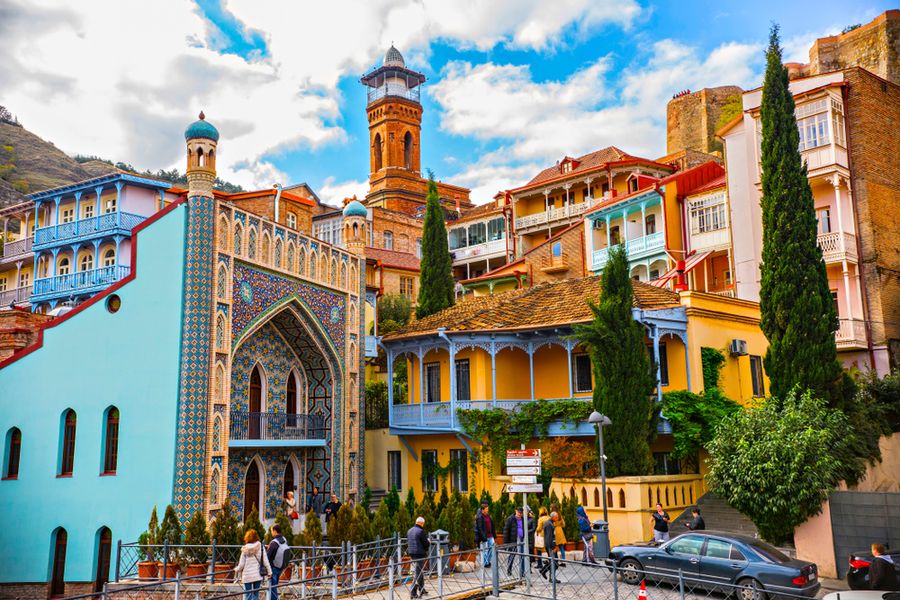
Most Americans can name several European capitals without much thought. Paris, Rome, Amsterdam — these cities have dominated the travel conversation for decades. But there is one capital that most people have never seriously considered, and it might be the most fascinating of all. Tbilisi, the capital of the Republic of Georgia, sits where Europe meets Asia, and it holds a depth of history, culture, and character that few cities anywhere can match.
A City Born From a Falcon and a Hot Spring
The story of how Tbilisi came to be sounds almost too good to invent. According to legend, a 5th-century king was out hunting when his falcon fell into a natural hot spring. Intrigued by the steaming, warm water rising from the earth, he decided to build his new capital on that very site. He named it Tbilisi — from the Old Georgian word for "warm" (source). That founding story is still honored today, with a bronze statue of that king standing guard from a hilltop above the city, looking out over the streets he set in motion fifteen centuries ago.
Tbilisi's location made it one of the most fought-over cities in history. Perched at the crossroads of Europe and Asia, it served as a vital stop on the ancient Silk Road trading network. Whoever held Tbilisi effectively controlled the entire Caucasus region and a critical stretch of that route (source). Arabs, Mongols, Persians, Ottomans, and Russians each took the city at different points across the centuries, and every one of them left something of their culture behind — in the architecture, the food traditions, the places of worship, and the way the city carries itself today.
A Skyline That Refuses to Make Up Its Mind
Tbilisi's Old Town is a maze of winding lanes, medieval stone churches, and wooden houses lined with ornate, intricately carved balconies that lean out dramatically over the street below. These balconies are among the city's most recognizable features, survivors of a building tradition that absorbed Persian, Russian, and European influences across many centuries (source). Fortress ruins crown the hilltops above the Old Town, and the Mtkvari River winds through it all, giving the whole scene a natural frame.
What makes the cityscape even more interesting is the unapologetic way old and new exist side by side. A sleek, glass pedestrian bridge spans the river just minutes from ancient stone walls. Soviet-era apartment blocks stand close to 6th-century basilicas. Modern wine bars open their doors in buildings that have been standing for three hundred years. In many European capitals, history is something you visit in a museum. In Tbilisi, it is simply the street you are walking down.
The Oldest Wine Tradition on Earth
Most travelers do not expect to arrive in what scientists have confirmed as the world's oldest wine-producing region, but the evidence is hard to argue with. Research places the earliest known winemaking in Georgia at around 6,000 BCE — making the tradition roughly 8,000 years old (source). That conclusion was reached by specialists from multiple countries who spent years studying ancient grape seeds and pottery remains found at dozens of sites across the country. Georgia is, by the available evidence, the birthplace of wine.
The traditional Georgian method centers on the qvevri, a large egg-shaped clay vessel buried underground, where grape juice, skins, seeds, and stems ferment together over several months. This ancient practice is still carried out today and has been recognized on UNESCO's list of Intangible Cultural Heritage (source). Wine runs through Georgian songs, poems, and celebrations — it is less a product than a cultural language. In Tbilisi, a lively natural wine scene has grown up around this deep tradition, and the wines it produces — often amber-hued and earthy — tend to come as a genuine and welcome surprise to American visitors.
Soaking in the Sulfur District
At the eastern edge of the Old Town lies Abanotubani, a neighborhood unlike anything else in Europe. Its name translates directly to "bath district," and the landscape delivers on that description. Rounded brick domes push up from the ground in clusters, each one capping a bathhouse fed by sulfur springs below (source). Steam drifts lazily between them, and the narrow, cobblestone paths give the whole area a surreal, unhurried quality that feels completely out of step with modern urban life — in the best possible way.
These baths have served Tbilisi for a very long time. By the close of the 13th century, historians recorded as many as 63 bathhouses operating throughout the city (source). They were never just places to wash up — they functioned as social gathering spots where friendships were formed, deals were struck, and the daily life of the city played out in warm, steam-filled rooms. Today, more than a dozen bathhouses still operate in the district, and visitors can rent private rooms to soak in the mineral-rich water. It remains one of the most quietly unforgettable experiences the city has to offer.
Europe's Best-Kept Secret Is Running Out of Time
Tbilisi rewards the curious. It is a city that has absorbed wave after wave of conquest, kept an 8,000-year winemaking tradition alive and evolving, and still greets visitors with a warmth that is increasingly rare in places that have been well and truly discovered by mass tourism. For American travelers looking for something beyond the predictable, it delivers something genuinely rare.
The rest of the world is beginning to take notice, and that will eventually change the texture of the place. For now, though, Tbilisi still belongs to the people willing to look past the familiar and sit with something different — a capital with ancient bones, a living pulse, and a long list of surprises waiting just around the next corner.