

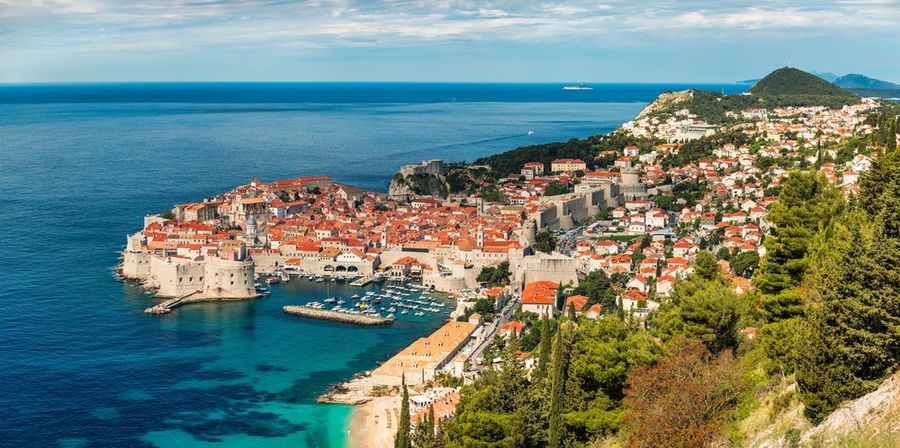
Croatia's Dalmatian Coast stretches along the eastern edge of the Adriatic Sea, a place where mountains tumble toward the water and hundreds of islands dot the horizon. Most first-time visitors head straight to Dubrovnik or Split — and for good reason. But beyond those famous cities lies a string of villages and towns that tell a quieter, richer story. From fortified medieval walls to fishing harbors barely touched by time, smaller destinations offer some of the coast's most rewarding experiences.
Trogir — A Living Museum by the Sea
Tucked onto a small island connected by bridges to both the mainland and a neighboring island, Trogir is one of the most completely preserved medieval towns anywhere on the Adriatic. National Geographic named it one of the top ten island cities in the world — an honor that feels well-earned the moment you step through its ancient stone gates (source). Intact buildings from the 1200s through the 1400s line the narrow streets, creating the sense of a place where time has simply refused to move on. Defensive walls, decorated gates, and a castle called Kamerlengo all add to the atmosphere of a city that takes its history seriously (source).
Founded by Greek settlers in 385 BC, Trogir's layered past is visible at every turn, and the Trogir City Museum offers a good introduction to the centuries of history packed into such a small space. The 154-foot bell tower of St. Lawrence Cathedral rewards those willing to climb its steps with sweeping views over the terracotta rooftops and out across the water (source). A fresh produce market just outside the old town gates is a good place to pick up local fruit before heading back in to explore the side streets. Old Town Trogir was designated a UNESCO World Heritage Site in 1997, a recognition that this is not just a pretty place but a genuinely important one.
Korčula — A Walled Town With Its Own Personality
Seen from the water, Korčula's old town rises like a dense cluster of rooftops ringed by stone towers and worn defensive walls — an image that has earned it frequent comparisons to a smaller Dubrovnik. The 14th-century walls that circle the old town can be walked without fees, offering views of the surrounding sea and the craggy mountains of the mainland just across the channel (source). In the heart of the old town, St. Mark's Cathedral anchors a web of narrow lanes lined with boutiques, restaurants, and small museums, including a town museum, a bishop's treasury, and an icon museum.
Korčula has a few strong claims to fame beyond its good looks. The town is widely recognized as the birthplace of the explorer Marco Polo, though most historians continue to cite Venice as his true place of origin. More certain is the island's exceptional wine culture — its vineyards produce varieties found nowhere else, and wine tourism has grown into one of the island's main draws in recent years. Korčula is also the only place in all of Dalmatia that still holds traditional sword dances during the summer months, a centuries-old performance tradition that has been carefully kept alive for locals and visitors alike (source).
Vis — The Island That Time Kept
Vis sits farther out in the Adriatic than most of its neighbors, nearly halfway to the Italian coast. For much of the 20th century, it served as a Yugoslav military base and was closed entirely to foreign visitors — a restriction that was not lifted until 1989. That long period of isolation left the island more traditional and quiet than its neighbors, and its old towns and fishing bays retain a strong sense of place that busier islands have slowly begun to lose.
Life in Vis town centers on the Riva, the broad waterfront promenade lined with restaurants, bakeries, and small shops where boats arrive and depart throughout the day. Tours to the Blue Cave and the island's interior can be booked along the Riva, including visits to the tunnels and bunkers left behind from the military era and the cave used by Tito during World War II (source). Film fans may recognize the island from the movie Mamma Mia — the production originally planned to film on Hvar, but relocated to Vis after finding the more popular island too busy and modern (source).
Ston — Salt, Walls, and the Adriatic Table
Ston sits quietly at the base of the Pelješac Peninsula, a small town that announces itself from a distance with a stunning sight: a medieval stone wall that snakes up the rugged hillside behind the terracotta rooftops. Built in 1358, the wall has earned the nickname "Europe's Great Wall of China," and it originally stretched more than four miles before sections were removed over the centuries, leaving 3.4 miles of ramparts that visitors can still climb today (source). Founded in 1333, Ston is recognized as Europe's second planned city, following Carcassonne in France.
The walls were not built to protect gold or a trading empire, but something that was nearly as valuable in medieval times: salt. The salt pans along the edge of town are among the oldest still-operating salt works in Europe, and they were the primary reason the nearby Republic of Ragusa — today known as Dubrovnik — poured so much effort into fortifying this stretch of coast (source). Just a short walk away in the sister town of Mali Ston, visitors can sample oysters freshly pulled from the bay, which is well-regarded along the entire Adriatic coast for producing exceptional shellfish. Pair the oysters with a glass of wine from the surrounding Pelješac Peninsula, which is known throughout Croatia for its vineyards, and Ston becomes one of the most satisfying stops on the entire coast (source).
The Coast Rewards the Curious
The most memorable places on the Dalmatian Coast rarely announce themselves loudly. A walled medieval town perched on a tiny island. A remote island that only opened its doors to outsiders within living memory. A quiet peninsula town guarding salt pans that have been in use for centuries. None of these places top the typical must-see lists, but each one offers something that the most famous cities — for all their beauty — cannot always deliver: the feeling of arriving somewhere that still has a little space left for you.
Whether you have a week or just a few extra days, adding even one of these smaller stops to your itinerary tends to be the part of the trip you remember longest. The Adriatic has been drawing travelers for centuries, and the best of it still waits a little off the main path.