

Energy costs keep climbing, and many U.S. households are looking for ways to use less power without giving up comfort. Fortunately, small, smart upgrades around the home can make a real dent in monthly bills. From the thermostat on your wall to the bulbs in your lamps, modern connected gear is built to save power and save you money. Understanding which common upgrades have the best odds of reducing your utility bills can lead to simple savings.
1. A Smart Thermostat
On average, an ENERGY STAR-certified smart thermostat trims about 8% off heating and cooling costs, which comes to roughly $50 a year for a typical home (source). The figure can climb higher in regions with bigger seasonal swings, where extreme temperatures across the year tend to hand bigger gains to users of these devices. The certification itself is not a marketing label — it is awarded by EPA-approved third-party bodies after analyzing actual field data from a wide sample of homes, rather than relying on bench tests.
These devices keep working in the background after you set them up. Modern smart thermostats are built to pick up on your preferences and automatically dial settings up or down based on occupancy and indoor and outdoor temperatures (source). You do not have to remember to change anything before walking out the door. If your household is occupied around the clock, the gains tend to be smaller — but most schedules leave plenty of room for meaningful trim over the course of a year.
2. Smart LED Bulbs Around the House
Lighting is probably the easiest place to start chipping away at an electric bill. Residential LEDs — especially ENERGY STAR-rated ones — pull at least 75% less energy than incandescent bulbs, and they keep working as much as 25 times longer (source). The result is fewer dollars on power and fewer trips to the hardware store for replacements.
There is a hidden benefit too. Incandescent bulbs lose about 90% of the energy they use as heat, and CFLs are not much better at 80% (source). LEDs barely warm up by comparison, which means more of the energy turns into actual light and less of it adds to the load on your air conditioner in summer. LED technology is currently considered the most energy-efficient and fastest-improving lighting option available, which is why nearly every new fixture is built around it. Adding smart features like app scheduling on top makes it easy to stop paying for lights nobody is using.
3. A Smart Power Strip for the Entertainment Setup
A lot of electronics keep sipping power while pretending to be off. With your TV, computer, and other appliances plugged in, they are quietly pulling current around the clock, even when the screens are dark. This standby load makes up between 5% and 10% of residential energy use, and could add as much as $100 to the typical U.S. household bill each year (source).
A power strip with on/off switches is one of the easiest fixes around. Plug a group of devices into one strip, flip the switch when they are not in use, and those devices are truly powered down rather than dozing (source). Many of the smart versions can do this for you on a schedule or sense when a main device (like the TV) has gone idle, which means you do not have to remember to hit the switch yourself.
4. Smart Plugs for Individual Devices
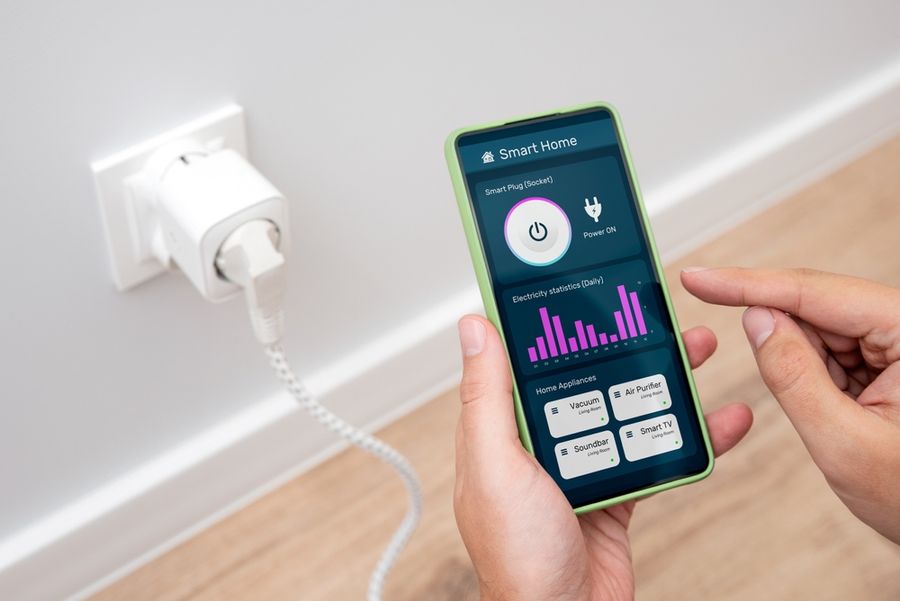
Smart plugs target the same phantom drain that strips do, but at the single-outlet level — handy for one-off appliances and chargers tucked into kitchens and offices. Some items make sense to leave on full time, like the alarm clock by the bed or the refrigerator in the kitchen. Plenty of others — the toaster oven is a common example — really do not need to stay live around the clock, which makes them perfect candidates for a smart outlet running on a schedule (source).
The kind of equipment you plug in matters too. Many ENERGY STAR-rated devices already pull less standby power than non-rated equivalents, so pairing newer ENERGY STAR gear with a smart plug stacks two improvements into one spot (source). Scatter a few of these outlets through the kitchen, office, and entertainment area, and the slow drips you do not see add up across a year.
5. A Heat Pump Water Heater with Smart Controls
Hot water is one of the larger pieces of any home energy bill, which makes the water heater a high-value target. Swapping a standard electric tank for an ENERGY STAR-certified heat pump model can save a family of four around $550 a year on its electric bill (source). That is a noticeable change to the monthly statement.
Look further out and the picture gets even better. Over the unit's life, savings can exceed $5,610 for a four-person household, and the higher upfront cost typically pays for itself within roughly three years for that same household size (source). Most newer heat pump water heaters also ship with app-based scheduling, which makes it easy to shift heating to off-peak hours or skip a cycle when nobody is home.
Steady Savings, One Step at a Time
Each upgrade on its own knocks a little off the bill. Run a few of them together and the dent grows real, all without changing the rhythm of daily life. The hardware quietly handles the work while you focus on everything else.
Start with whichever fits your home best. Heating and cooling running the bill up the fastest? Lead with the thermostat. Old bulbs still in your sockets? Knock those out next. Tank water heater nearing the end of its run? The heat pump model is a strong long-term play. Each upgrade redirects a few dollars from the utility back into your own pocket — and tends to leave the place a little more comfortable in the bargain.