

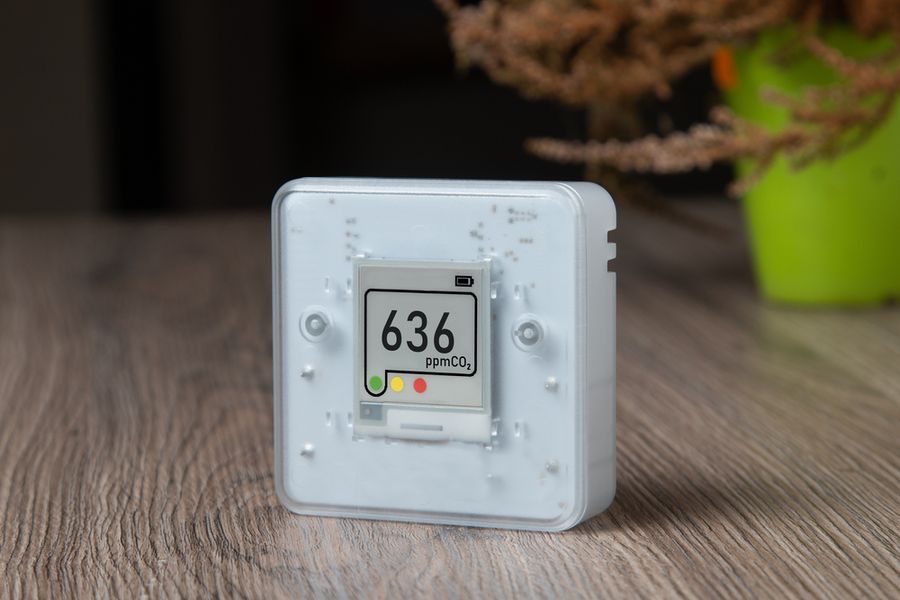
Indoor air can change quickly when someone cooks, cleans, paints, lights a candle, or closes the windows for the night. A smart air quality monitor helps make those changes visible by tracking particles, gases, temperature, and moisture over time. The most useful models do more than show a single score. They identify individual readings, store trends, send alerts, and help users decide whether to ventilate a room, run filtration, or investigate a continuing problem.
Airthings View Plus: Best Overall Monitor
The Airthings View Plus tracks radon, PM2.5, carbon dioxide, volatile organic compounds, temperature, humidity, and air pressure. Its e-ink display can show up to four selected readings, while a motion-activated light uses green, yellow, and red to give a quick view of current conditions. Wi-Fi access also allows users to review alerts, trends, and live readings in the Airthings app.
The monitor can run on six AA batteries or USB-C power. Battery life can reach up to two years, depending on settings and network conditions, while USB-C power also enables hub support for compatible Airthings Wave devices. Radon readings become more useful over time, so the View Plus is better for ongoing monitoring than for a quick one-time check.
Pros
- Tracks seven indoor conditions
- Includes radon and PM2.5 monitoring
- Offers app alerts and trend history
- Works on batteries or USB-C power
- Can support compatible Airthings devices as a hub
Cons
- Some sensors require calibration time
- Radon readings improve gradually
- Best results depend on long-term placement
- Broader features may be unnecessary for simple monitoring
Awair Element: Best for Simple Daily Guidance
The Awair Element measures PM2.5, carbon dioxide, volatile organic compounds, temperature, and humidity. Current readings appear on the device, while the Awair Score combines them into a simpler overall result. The no-fee app adds remote access, selected alerts, trend history, outdoor comparisons, and suggestions based on changing indoor conditions.
The Element connects through 2.4 GHz Wi-Fi and must remain plugged in during use. It does not include a built-in battery, so buyers should choose a room where they want steady long-term readings. Its five-sensor setup works well for bedrooms, offices, and living areas, but it does not include radon or several other gas sensors.
Pros
- Easy-to-read overall air quality score
- Tracks five useful indoor conditions
- Includes a no-fee app and remote access
- Provides alerts, trends, and guidance
- Simple enough for first-time users
Cons
- Requires constant power
- Uses 2.4 GHz Wi-Fi
- Does not track radon
- Less suitable for advanced smart-home setups
- One unit may not reflect conditions throughout a home
AirGradient ONE: Best for Data Control and Smart Homes
The AirGradient ONE measures PM2.5, carbon dioxide, total volatile organic compounds, nitrogen oxides, temperature, and humidity. It includes an OLED display and programmable indicator lights, and it connects through 2.4 GHz Wi-Fi. Readings can be sent to the AirGradient dashboard or another compatible platform.
Its open-source design allows owners to review the hardware and software, adjust settings, use their own server, or connect the monitor with Home Assistant and Homey. The company dashboard includes charts, custom alerts, and scheduled reports, while the assembled model includes 12 months of platform and API access. This flexibility is valuable, but it makes the monitor more technical than simpler app-based options.
Pros
- Tracks six indoor conditions
- Open-source hardware and software
- Supports Home Assistant and Homey
- Can send data to a private server
- Includes charts, alerts, and reports
Cons
- Steeper learning curve
- Requires 2.4 GHz Wi-Fi
- Platform access is time-limited
- May be too technical for basic monitoring
- Best features require more setup than plug-and-play models
uHoo Caeli: Best for Multiroom Monitoring
The uHoo Caeli is designed for households that want to track conditions across several rooms. Its entry membership includes the monitor, continuous readings, mobile app access, alerts, guidance, room information, and family sharing. Additional devices can be added and managed through the same account.
Higher membership levels add deeper reports, risk indexes, room comparisons, personal insights, and smart-home support. The top plan includes connections with Apple Home, Google Home, Amazon Alexa, SmartThings, and Home Assistant. The system is convenient for whole-home monitoring, but its annual membership structure creates an ongoing cost.
Pros
- Designed for multiroom monitoring
- Supports family sharing
- Includes alerts and guided information
- Higher tiers add deeper reports and comparisons
- Works with several major smart-home platforms
Cons
- Requires an annual membership
- Additional rooms increase the total cost
- Advanced features are limited to higher tiers
- Less practical for one-room use
- Buyers must compare plan details carefully
Which Indoor Conditions Should a Monitor Track?
PM2.5 monitoring is useful for detecting fine particles created by cooking, candles, smoke, outdoor pollution, and some household activities. These readings can help users see whether opening a window improves the room or brings outdoor smoke inside. They can also show how quickly an air purifier lowers particle levels after a spike.
Carbon dioxide is mainly useful as a sign of ventilation. It often rises when several people occupy a closed room or when bedroom doors and windows remain shut overnight. A monitor cannot remove the gas, but a clear pattern may show when fresh-air ventilation is needed.
Volatile organic compound sensors respond to gases released by items such as cleaning products, paint, adhesives, furnishings, fragrances, and personal care products. Consumer monitors usually report a combined VOC reading rather than identifying each chemical. Alcohol, sunscreen, and other harmless substances can also trigger these sensors, so one high reading does not prove that a dangerous chemical is present.
Temperature and humidity readings add important context. High humidity may point to a need for moisture control, while very dry air can affect comfort. Radon requires a dedicated sensor and is not included in most general air monitors. Buyers who specifically need radon tracking should confirm that the product measures it rather than assuming every air quality device does.
How to Choose a Smart Air Quality Monitor
Choose a monitor based on the conditions you actually need to track, not the longest sensor list. Check whether the device includes the specific readings that matter in your home, then review how much history it stores, whether alerts can be customized, and whether data can be exported or shared.
Also look closely at setup and long-term use. Confirm the Wi-Fi requirements, power source, app compatibility, subscription terms, and whether more than one household member can access the account. A monitor is most useful when its readings are easy to understand and its core features remain available without unexpected limits.
Where to Place an Air Quality Monitor
Place the monitor in a room where people spend a lot of time or where a specific concern occurs. A bedroom can reveal overnight carbon dioxide buildup, while a kitchen may show particles and VOCs from cooking. Keep the device away from open windows, doors, vents, fans, humidifiers, and purifier outlets unless the goal is to test one of those sources, since direct airflow can distort the reading.
Give the monitor time to settle before judging the results. Leave it in one location for several days, watch for repeated patterns, make one change, and then compare the new readings. Since air quality can vary from room to room, one monitor may not represent the whole home, especially when doors stay closed or different floors use separate heating systems.
Turning Readings Into Useful Changes
The Airthings View Plus is the strongest all-around option for households that want wide sensor coverage and radon monitoring. Awair Element provides a simpler experience for tracking the most common indoor conditions. AirGradient ONE offers greater data freedom and automation potential, while uHoo Caeli is designed for guided, subscription-based monitoring across several rooms.
A smart monitor does not clean the air or diagnose the source of every spike. Its value comes from showing when conditions change and whether a response makes a measurable difference. By comparing readings before and after ventilation, filtration, moisture control, or changes in household habits, users can replace guesswork with a clearer picture of the air inside their homes.