

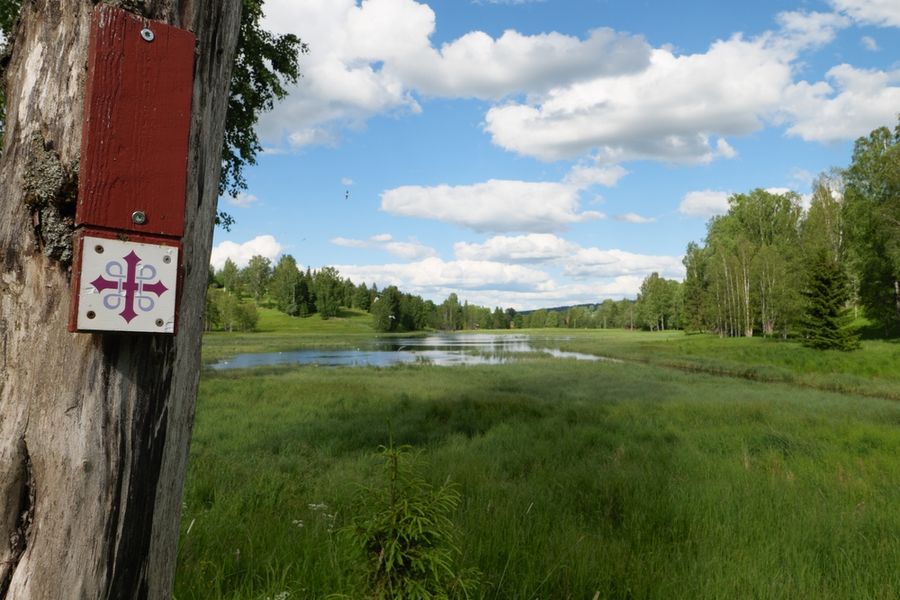
Norway’s St. Olav Ways offer something many famous pilgrimages cannot: a strong sense of history without the feeling of following one fixed route. The paths cross forests, valleys, farms, mountain plateaus, and small communities before reaching Nidaros Cathedral in Trondheim. Pilgrims can walk for a few days or commit to a journey lasting several weeks. That mix of choice, meaning, and wild Nordic scenery makes St. Olav Ways worthy of much wider attention.
A Pilgrimage Rooted in a Thousand Years of History
The journey centers on Olav II Haraldsson, the Norwegian king later known as St. Olav. He ruled Norway from 1015 to 1028 and died at the Battle of Stiklestad in 1030. After his death, he was declared a martyr and saint. Pilgrims began traveling toward his burial place in Nidaros, the medieval name for Trondheim, and the city grew into one of Northern Europe’s major pilgrimage destinations.
The modern route network carries that history into the present. The St. Olav Ways were certified as a Cultural Route of the Council of Europe in 2010. The wider network reaches across Norway, Sweden, Denmark, and Finland, linking old paths, religious sites, and Nordic cultural traditions. A walker is therefore not simply taking a scenic hike. Each stage forms part of a larger story shaped by travel, faith, and contact between communities.
Nine Routes Create More Than One Kind of Journey
In Norway, the St. Olav Ways are known together as Pilegrimsleden. Nine named paths lead toward Nidaros Cathedral: Gudbrandsdalsleden, St. Olavsleden, Borgleden, the Coastal Pilgrim Route, Tunsbergleden, Østerdalsleden, Valldalsleden, Romboleden, and Nordleden. Some approach Trondheim through inland valleys and mountains, while others follow coastal areas or connect with routes that begin in Sweden.
This variety supports travelers with different goals. A first-time pilgrim can choose a developed path with clearer services, while an experienced hiker can consider steeper or less connected sections. Travelers can also select a short stage instead of treating the full route as an all-or-nothing challenge. That flexibility makes the St. Olav Ways easier to fit around work schedules, fitness levels, and the amount of solitude a pilgrim wants.
Gudbrandsdalsleden Offers the Classic Long Walk
Gudbrandsdalsleden is the best-known choice for pilgrims who want a full journey through Norway. The marked trail runs about 643 kilometers, or roughly 400 miles, from Oslo to Trondheim. It crosses cultural landscapes, forests, the Gudbrandsdalen valley, and the broad Dovrefjell mountain plateau before reaching the cathedral. Walking the whole route commonly takes around 32 days.
North of Oslo, the trail divides into eastern and western branches around Lake Mjøsa before meeting again near Lillehammer. The western side passes through Krokskogen and Hadeland, while the eastern side crosses farming areas and includes Hamar. This split lets travelers shape the opening part of the pilgrimage around the places and landscapes that interest them most.
A month-long walk is not required. A rail line runs close to much of Gudbrandsdalsleden, making it possible to reach different starting points and complete selected stages. Summer is the recommended walking period, generally from June through the start of September, because snow, meltwater, and seasonal closures can affect the trail outside that window. Dovrefjell may require an even later June start.
The Landscape Is Part of the Pilgrimage
Gudbrandsdalsleden passes burial sites, old churches, preserved buildings, farms, forests, villages, and mountain country. Other St. Olav paths cross lakeside areas, coastal settlements, and border regions. The changing land keeps the walking experience from feeling like a repeated daily march and allows each route to create its own sense of place.
That setting supports the slower rhythm many pilgrims seek. Long stretches of walking leave room for prayer, thought, conversation, or simple attention to weather and terrain. A traveler does not need to follow one religious practice to value that pace. The paths can serve committed Christians, history-focused walkers, outdoor travelers, or people marking a change in their lives. Their strength lies in giving each person room to define the purpose of the journey.
Practical Planning Can Match the Route to the Traveler
The route’s planning tools help travelers map stages, choose a path, identify places to sleep, and find cultural or natural stops along the way. Pilgrims can also review recommended trips instead of building an itinerary entirely from scratch. Because services and lodging differ between paths, daily distances and overnight stops should be checked before departure.
Pilgrims should also prepare for uneven ground, changing weather, and stretches with limited services. The best schedule begins with honest daily mileage rather than a goal copied from another walker. Shorter days, rest time, and extra space around mountain stages can keep the calendar from taking control of the experience.
This flexible planning is one of the route network’s biggest advantages. A traveler can use rail access to shorten Gudbrandsdalsleden, walk a recommended section, or build a trip around the final approach to Trondheim. A meaningful pilgrimage does not become less valid because it fits into one week instead of five.
The Pilgrim Passport Turns Miles Into Memories
A pilgrim passport adds a simple ritual to the walk. Stamps can be collected at pilgrim lodgings, regional centers, some churches, museums, and other stops. Over time, the passport becomes a record of the route, with each mark tied to a place, a host, or a day on the trail.
Walkers who document at least the final 100 kilometers to Trondheim can qualify for the Olav Letter. The passport must be presented in person at the pilgrim reception near Nidaros Cathedral. Suggested qualifying walks include Berkåk to Trondheim on Gudbrandsdalsleden and Stiklestad to Trondheim on St. Olavsleden. Cyclists follow a longer distance rule, while the Coastal Pilgrim Route uses a separate stamp system.
The passport and letter are not the main reason to take the journey, but they give the experience a useful structure. Collecting stamps encourages pilgrims to pause in villages, churches, and lodgings rather than hurry through every stage. The finished passport becomes a physical reminder of the people and places that shaped the walk.
Trondheim Provides a Destination With Real Weight
Every route is directed toward Nidaros Cathedral, built over the burial place of St. Olav. Construction began in 1070, and Trondheim became the leading pilgrimage destination in medieval Northern Europe. The cathedral remains Norway’s national shrine and has welcomed pilgrims for close to a thousand years.
That endpoint gives the journey a clear emotional shape. After days or weeks of country paths, farms, hills, and small towns, the arrival is not simply a stop at a trail marker. Pilgrims can complete their passport, receive the Olav Letter when eligible, enter the cathedral, and spend time in Trondheim. The long approach makes the finish feel earned rather than staged.
The cathedral also keeps the pilgrimage connected to a living place rather than a distant legend. Services, concerts, tours, and continuing restoration work bring new activity into a building shaped by centuries of faith and national history. Arriving on foot allows pilgrims to meet that space slowly, with the distance already traveled still fresh in mind.
A Nordic Pilgrimage Worth the Journey
The St. Olav Ways deserve a place beside better-known pilgrimage routes because they combine choice with a strong destination. The history is deep, but the trip does not demand one belief or one fixed schedule. A pilgrim can cross Norway from Oslo, walk the final 100 kilometers, approach from Sweden, or choose a shorter stage that still carries the meaning of the larger network.
For American travelers, the journey offers a focused way to experience Norway beyond a quick city visit or scenic drive. It asks for time, effort, and attention, then gives those things back through landscape, history, and a memorable arrival in Trondheim. Pilgrims searching for a quieter European route with a clear purpose may find that the St. Olav Ways are exactly the path they have been waiting to walk.