

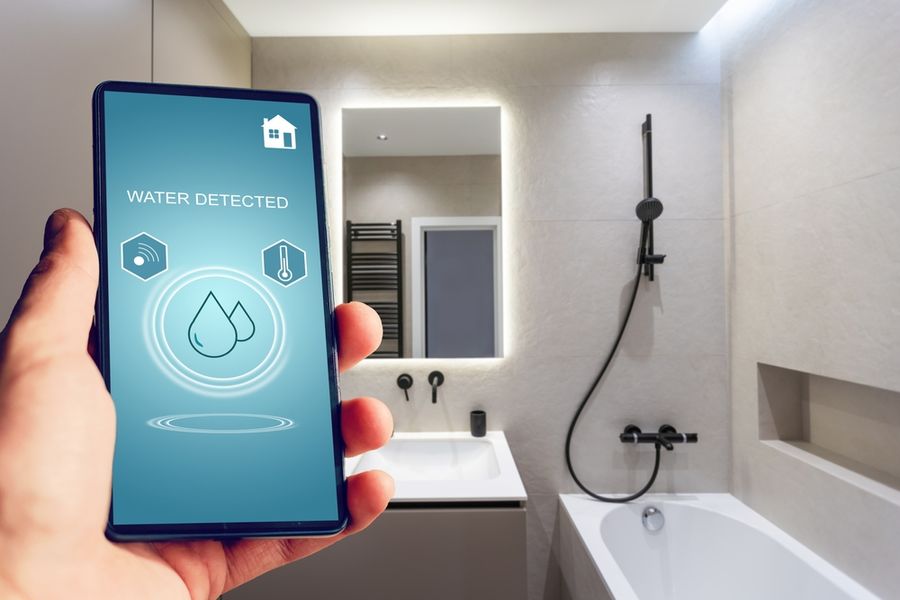
A loose hose, cracked pipe, or failing water heater can release a surprising amount of water before anyone notices. Smart leak sensors provide an early warning by detecting moisture in places that are rarely checked. Newer models can also track freezing temperatures, sound a local alarm, and send alerts to a phone. Choosing the right sensor and placing it carefully can give homeowners more time to respond before a small drip spreads.
What Today’s Smart Water Leak Sensors Can Detect
A basic water sensor has metal contacts that trigger an alarm when water completes a small electrical circuit between them. This design works well for pooling water beneath a sink, washing machine, toilet, refrigerator, or water heater. Some newer sensors place contacts on both the top and bottom, allowing them to detect water dripping onto the unit as well as water spreading across the floor.
Many current models go beyond simple moisture detection. They may watch for low temperatures that could lead to frozen pipes, high humidity that may affect stored belongings, or sudden changes in room conditions. The First Alert L1 WiFi Water Leak and Freeze Detector, for example, monitors water, temperature, and humidity. It can send mobile and email alerts when a leak appears or when environmental readings move outside the limits selected by the user.
These extra readings do not identify every plumbing problem. A sensor sitting on a dry floor will not necessarily detect a slow leak hidden inside a wall. However, it can provide valuable notice when water reaches a high-risk area. The main benefit is speed: a phone alert may reach a homeowner while the leak is still limited to the floor around an appliance.
Ring Flood & Freeze Sensor Adds a Simpler Connection Option
Ring introduced a newer Flood & Freeze Sensor as part of its expanded home-safety lineup in 2026. Unlike the earlier Ring Alarm accessory, the updated model does not require a Ring Alarm base station. It connects through Amazon Sidewalk, a shared low-bandwidth network designed to help compatible devices remain connected beyond the normal reach of home Wi-Fi. Amazon Sidewalk coverage is required and may differ by location.
The sensor is designed to warn users when it detects water or when the surrounding temperature falls below 40 degrees Fahrenheit. It can be placed near sinks, washing machines, water heaters, or other fixtures where leaks may begin. The low-temperature warning is especially useful in basements, utility rooms, garages, and other areas that may become colder than the main living space.
This model may appeal to households that already use Ring products but do not want to install a full security system simply to monitor for leaks. Still, buyers should check Amazon Sidewalk availability and review the privacy and network settings connected with that service. A sensor with easy installation offers little protection if it cannot maintain a dependable connection in the room where it is needed.
YoLink Water Leak Sensor 4 Is Built for Difficult Locations
The YoLink Water Leak Sensor 4 is designed for areas where ordinary Wi-Fi signals may struggle, such as basements, crawlspaces, detached garages, and larger homes. It uses a long-range LoRa-based connection to communicate with a required YoLink hub. The sensor can also work directly with certain YoLink devices, allowing supported local actions to continue even when the internet connection is unavailable.
This model has sensing contacts on its upper and lower surfaces. The bottom contacts can react to water spreading across a floor or appliance tray, while the upper contacts can catch drips falling onto the device. A built-in 105-decibel alarm provides a strong local warning, and low-temperature detection can alert the household to conditions that may place pipes at risk. Its IP66-rated housing also offers protection against dust and forceful water spray.
A hub-based system makes the most sense when several sensors will be installed. One unit can watch the water heater, while others cover the laundry area, sump pump, kitchen sink, and bathrooms. Buyers interested in this model should include the hub in their plans unless they already own a compatible YoLink system.
First Alert L1 Covers More Ground With a Sensor Cable
Puck-shaped detectors monitor a small area immediately around the device. The First Alert L1 WiFi Water Leak and Freeze Detector takes a different approach by including a five-foot sensing cable. Water can trigger the alarm at any point along the cable, making it useful for covering the edge of a water heater, running behind laundry appliances, or following part of a basement wall.
Additional cables can be connected to extend the monitored area to as much as 500 feet. The detector connects directly to Wi-Fi and does not require a separate hub. It can produce a 100-decibel local alarm while also sending remote notifications. Its batteries are rated to last up to three years when no incident occurs, although actual life can be affected by signal strength, alert frequency, and environmental conditions.
The cable should be placed where escaping water is likely to travel rather than simply stretched across the center of a room. In a utility space, that may mean looping it around the base of a water heater or running it beside a sump pump. A shorter cable in the right path can be more useful than a long cable placed without regard to the floor’s slope.
Phyn Offers Adjustable Temperature and Humidity Alerts
The Phyn Smart Water Sensor combines moisture contacts with temperature and humidity monitoring. When it comes into contact with water, it can provide audible and visual warnings along with app and text-message notifications. Users can also set their own high and low limits for temperature and humidity in the Phyn app.
Each sensor normally monitors one area, but optional cables and extension nodes can widen its reach. This flexibility can help in spaces where the main sensor should remain visible or accessible while the sensing point needs to sit behind an appliance. Phyn Smart Water Sensors can be configured to trigger a connected Phyn Plus unit to shut off the home’s water supply when a sensor detects water.
Adjustable limits are useful because rooms do not all have the same normal conditions. A basement may be cooler and more humid than a kitchen, while a seasonal home may need a low-temperature warning set well above freezing. Homeowners should avoid setting limits so narrowly that harmless changes create repeated alerts. Too many false warnings can lead people to ignore the notification that truly matters.
Eve Water Guard Uses a Long Sensing Cable
Eve Water Guard is a plug-in detector that uses a sensing cable rather than relying only on contacts beneath a small puck. Its cable can be placed along cabinets, walls, appliances, or other areas where water might spread. When moisture reaches the cable, the unit provides an audible alarm and a visual warning while sending a notification through the connected smart-home system.
The current model supports Thread, a low-power networking system used by many newer smart-home devices. A compatible Thread border router, such as a supported home hub, is needed. Because Eve Water Guard remains plugged into an outlet, it can also act as a routing point that helps pass Thread data between nearby devices.
Continuous power removes the need to replace sensor batteries, but it also limits placement to areas with an available outlet. Buyers should make sure the cord and main unit can remain dry and secure while the sensing cable rests in the leak-prone area. This model is best suited to households that already have the required home hub or plan to build a wider Thread-based system.
Strategic Placement Matters More Than Sensor Count
The most important locations are usually close to appliances and fixtures that hold or move large amounts of water. Start with the water heater, washing machine, dishwasher, sump pump, refrigerator water line, and the cabinet beneath each sink. Toilets and HVAC drain lines may also deserve coverage, especially on upper floors where leaking water can damage the rooms below.
Place each sensor at the point where water is likely to collect first. Check the slope of the floor and look for drain pans, low spots, pipe openings, and cabinet edges. A sensor pushed far beneath an appliance may be difficult to test or silence, while one placed too far away may not react until the leak has already spread.
Connectivity should be tested before the sensor is left in position. Send a test alert, confirm that every intended household member receives it, and check the local alarm from another room. Sensors in detached buildings or deep basements may need a long-range system, additional network equipment, or a different placement.
Build a Routine Around Testing and Response
A smart sensor should be tested according to its instructions after installation and then checked regularly. Battery status, cable condition, app access, notification permissions, and network connection can all change over time. After a real leak, the detector and sensing cable should be cleaned and dried as directed before being returned to service.
Every household also needs a clear response plan. Residents should know where the main water shutoff is located and how to close it. Alerts can be shared with another family member, neighbor, or property manager when a home is often empty. Automatic shutoff systems offer another level of protection, but their compatibility, installation requirements, and operating rules should be reviewed carefully.
No sensor can repair a broken pipe or replace routine plumbing maintenance. Its role is to shorten the time between the start of a leak and the moment someone takes action. That smaller window can make the difference between wiping up water around an appliance and repairing damage across several rooms.
Early Alerts Create More Time to Act
Smart water leak sensors are most useful when they lead to a fast, organized response. Once the devices are installed, households should keep contact information current, retest the system regularly, and address every alert promptly.
The technology is simple, but the extra warning it provides can help turn an unexpected leak into a manageable cleanup rather than a much larger repair.